[R] Record
Real footage, real photographs, real audio, real documents. Presented plainly. Unaltered.
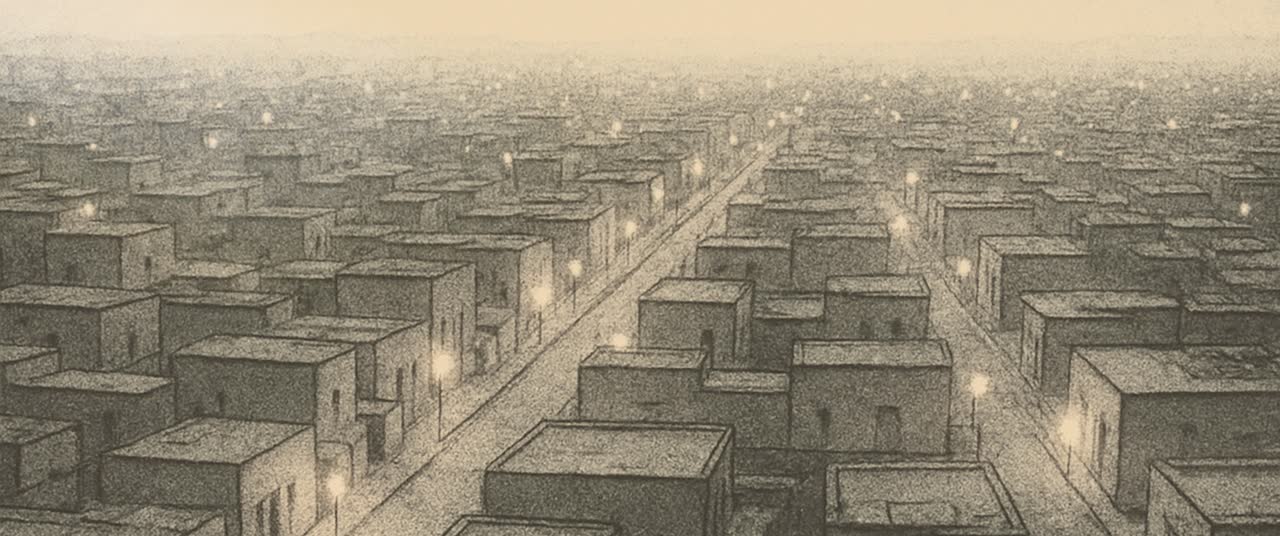
Two cuts, built from the same declared register system. What you are watching is told to you on every frame.
The film has three visual registers and the audience is told which one they are in at every moment. This is the film’s signature, not its limitation — Flee and Waltz with Bashir both won their reputations on exactly this move.
[R] Record
Real footage, real photographs, real audio, real documents. Presented plainly. Unaltered.
[X] Reconstruction
Synthetically generated imagery for what was never filmed: Sadr City streets in 2005, the water trucks, the night patrols, the Starship corridor. Rendered in a declared, consistent, openly non-photoreal style — a look the audience reads as memory, not footage. The style itself does the labelling in the moment.
[T] Testimony
People on camera now, speaking for themselves. Boone’s own recorded voice throughout, never simulated saying anything he did not say.
Every frame you will see is reconstruction. No archival footage has been licensed yet, so wherever the cut needs record — Tahrir Square in October 2019, the Golden Shrine, Boone’s own photograph — it holds an honest card naming what has to be cleared, rather than substituting something that looks close enough. Nothing has been passed off as archive. The testimony cards work the same way: not one of those interviews has been shot.
Every voice in both cuts is synthesised, and every one is labelled on screen while it speaks. Boone Cutler’s lines are his own written words read by a stand-in voice, which the reconstruction brief permits only once the estate’s digital-likeness consent is executed — so these cuts are development material, and his authentic recorded voice replaces every one of those lines before anything is shown publicly. That substitution is the first job in the production order, and it is what the audio archive exists for.
The tone piece. Three and a half minutes built so that a financier who stops watching at ninety seconds has already seen the thesis and the craft. One instrument, entering once, at the Tahrir cut. Nothing before it.
The proof-of-concept scene. One sector, two days, no combat, seven speaking parts. It exists to demonstrate the only thing a buyer needs to believe: that persuasion is more cinematic than gunfire. It also ends in a win, which the rest of the film mostly does not.
No talking-head explaining what PsyOp is.
No map graphics, no news-anchor montage.
He never appears on screen. Not generated, not archival, not implied.
The film’s argument is that persuasion is intimate. A percussion bed under the craft section would contradict it in thirty seconds.